First Principle Thinking for Product Innovators
In a small workshop, a man meticulously worked on an idea to make knowledge accessible for everyone. His era was way before social media and the internet, when 90% of the world's information is shared online. During his time, books were equivalent to private jet travel — reserved only for elites. In the year 1440, Johannes Gutenberg invented the printing press. His invention profoundly changed the way information was broadcasted to the masses. In the following centuries to come, his innovation accelerated scientific progress, religious reformations, and political revolutions.
Product professionals have opportunities to change the world by bringing valuable products to life, just as Gutenberg did, by relying on First Principle Thinking.
Imagine having a toolkit with spanners to unlock innovation bolts of your product by enabling you to break down complex problems and make bold decisions. This article is a structured set of probing questions, grounded in first principle thinking. It will help you and your team to create innovative, user-centered, exceptional product experiences.
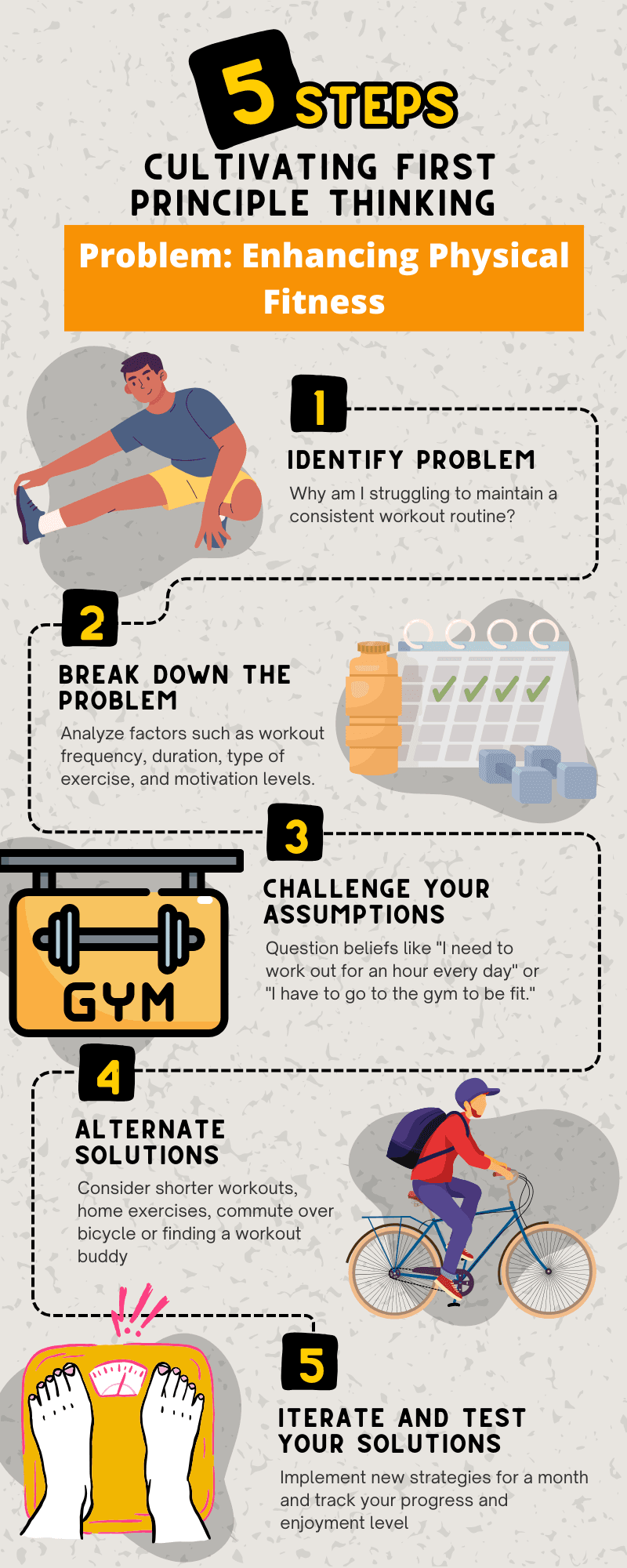
Let's first understand how you can apply first principle thinking to everyday problems, such as setting up a consistent workout routine.
Influence of First Principle Thinking
First principle thinking helps you to break down intricate problems into basic building blocks. This framework is a powerful tool for everyone involved in product creation and innovation — entrepreneurs, product managers, product designers, and product engineers. For general information on First Principles, read this Wikipedia article.
First principle thinking helps you to:
Identify Core User Needs
By understanding what your users truly require, you can develop products that exceed their expectations. A survey by Bain & Company found that companies that focus on customer needs, rather than product features, increased their customer loyalty by up to 25%.
Foster Innovation
Deep diving into established behaviors and norms leads you to novel ways of thinking. Apps like TikTok were created out of a need to address a more engaging social experience, than just photo sharing.
Reduce Complexity
Simplifying your understanding of market demand by focusing on core needs helps your team to develop the product in a more scalable way. For instance, Apple's commercial success lies in its ability to simplify the product experience and lead with innovation.
Now that you understand the importance of First Principle Thinking in product innovation, let's understand probing questions based on First Principle Thinking.
First Principle based Product Innovation
"The important thing is not to stop questioning. Curiosity has its own reason for existence." — Albert Einstein
At the root level, First Principle based Product Innovation underscores the fact that innovation does not merely arise from replicating the existing solution, but from knowing the fundamental elements involved in the product creation process. You can extract this knowledge by probing deep inside the problem at hand. By stripping away the complexities, and reviewing the problem from basics, product teams can unlock potential for true innovation.
Following are key characteristics of these probing questions:
- They require you to simplify the problem, making it easier to understand and explain to a 10-year-old kid.
- They question our assumptions and force us to consider better alternatives.
- They are grounded in data and not opinions.
- They often seek more information through a series of follow-up questions.
The following sections list sets of probing questions that help you instill First Principle based product innovation in your team. Consider these questions similar to your travel itinerary for your upcoming international travel that eases your planning and relieves you from stress. You can navigate directly to the relevant segment of probing questions based on the challenges of your role. However, I recommend you explore all the segments to foster innovation, empathy, and collaboration amongst all product creators.
Product Management: Turning Ideas into Realities
Market Research and Competitive Analysis
Market Segmentation
Understand which group of users/customers exhibit significant opportunities. Articulate the unique needs of the individual group, which further helps in targeting the right audience with the right product capabilities.
Probing questions:
- What are the core characteristics (demographic, geographic, psychographic) of each segment?
- What unique needs are possessed by the individual segment?
- How far can we break the segment further into sub-segments so that they have unique characteristics? Do these sub-segments provide unique opportunities?
- Which segment creates the largest impact? How do we measure the impact?
Example: Nike divides its market into different segments via type of sports, and further divides these segments based on pro athletes and casual enthusiasts. Nike tailors their products towards the unique needs of the individual segments and sub-segments.
Foundational Market Needs
Understand the core needs that shape user behavior and market demand.
Probing questions:
- What are the specific pain points unaddressed within my target market?
- How do these pain points align with the broader trends in the relevant industry?
- Are these needs or pain points deeply rooted (perpetual) or do they tend to change over time?
Example: Netflix in the early 2000s identified that users want flexibility in the type and time they watch content. Understanding this core need led to on-demand streaming, which further reshaped the industry.
Market Trends
Research underlying causes behind the emerging market trends. Be more adaptive, and proactive with defining product strategies that navigate through these trends.
Probing questions:
- What are the primary drivers behind the market trends?
- What are the hidden market trends?
- Which are the mega-trends affecting the majority of the industries including the one we serve?
- Are these trends transient or long term? Are they localized or global trends?
- How is our competition adapting to these trends?
- Are there any opportunities to create our own product category to address these trends?
Example: An environmentally friendly shopping trend led Patagonia to create environmentally friendly clothing and right practices, thereby creating a loyal and ever-growing customer base.
Competitive Landscape
Identify the opportunities and differentiation by knowing the competition with their strengths and weaknesses.
Probing questions:
- How are our competitors addressing the core needs?
- Are we getting blindsided by our competition? Should we avoid the 'addressing feature-gap' catchup?
- What feature-gaps are critical to address?
- What is our unique value proposition against our competition?
- Are there any innovations in our product that we should protect under patents?
Example: Notion entered a note-taking apps landscape dominated by existing giants like Evernote, OneNote, and Google Docs. Yet Notion crafted a niche by positioning itself as an all-in-one workspace — offering everything from note-taking to knowledge bases to task management.
Strategy and Roadmap
Product Vision
Product vision serves as a lighthouse to guide all product decisions and acts as inspiration for the teams involved.
Probing questions:
- What problems does the product aim to solve and address user needs?
- How does the product vision align with the organization's mission and vision?
- What is our desired state of the product after five years?
- How do our product offerings differentiate from the competition?
- What industry trends and megatrends can we leverage for our vision?
- How do we measure success in achieving our product vision?
Example: Patagonia, an outdoor apparel company, has embodied its commitment to environmental sustainability in its vision. Their products and actions reflect the vision — from selecting sustainable materials for their products to creating repairable products.
Prioritisation & Product Goals
Product goals will help you to move towards your vision in an incremental, progressive manner, while delivering value to the business and customer on its way.
Probing questions:
- What are the short-term and long-term goals that support our vision?
- How do we break the goals into achievable steps and initiatives?
- What is our criteria to prioritize the features and enhancements?
- What metrics do we measure to ensure we are progressing towards our goals?
- How do we prioritize the initiatives and features based on impact, feasibility, and alignment with our vision?
- When and how do we involve our teams to contribute to the goals?
- How often do we revisit our goals to keep them relevant?
Example: Slack's early focus on running feedback loops helped them set short-term goals. This led to user satisfaction, further triggering widespread product adoption.
Product Roadmaps
Roadmap planning and communication help you achieve streamlined development and alignment with stakeholders.
Probing questions:
- Who are the stakeholders who influence product roadmaps?
- How frequently should we communicate the product roadmap to various stakeholders?
- What themes and initiatives should we outline in the roadmap?
- How do we present the timelines, and what should be the granularity of the timeline?
- What level of detail should we include in the roadmap to avoid unnecessary questions and distractions?
- What should be the primary dimension that we apply to the roadmap — user persona based (analyst, business admin etc.), or theme-based (product scale, increase user satisfaction etc.), or category-based (e.g. technical, platform, functional)?
Example: During the COVID-19 pandemic, Airbnb fast-tracked safety, flexibility, and traveler preferences by adapting to market shifts in their roadmap, including flexible cancellation policies and cleaning protocols.
Go-to-Market Strategy
Positioning and Messaging
Define and understand the target market and align the product's value proposition with customer outcomes effectively.
Probing questions:
- What specific needs does our product solve for the target audience?
- Who are our ideal customers, and what are their characteristics?
- What are our key differentiators?
- How are we going to test our assumptions that the product positioning and messaging resonates with our target customers?
- What are the channels most effective to communicate with our target audience?
- What are the barriers of entry in each market segment?
Example: Royal Enfield, an iconic Indian motorcycle brand, has cultivated a loyal following by appealing to motorcycle enthusiasts who appreciate ruggedness, heritage, and classic-looking bikes.
Launch Planning
This involves creating a detailed plan for launching the product in the respective market. This includes timelines, resource planning, and key activities.
Probing questions:
- What outcomes do we expect and against what metrics should we measure them (e.g. user engagement, revenue, user acquisition etc.)?
- What potential risks could arise during the launch, and how can we tackle them?
- What customer feedback mechanism should we implement?
- How do we ensure that all related entities are informed about the launch ahead of time so that they can plan their activities?
- Have we enabled field teams with the supporting material required for the launch and customer adoption?
Example: VanMoof, a Dutch bicycle manufacturer, launched its Electrified S2 electric bikes in 2018. This launch showcased innovative tech and revealed effective launch planning. Their product launch leveraged various strategies like gauging perfect launch timing, crowdfunding, social media marketing, influencer marketing, etc.
Product Design: Crafting Delightful Experiences
Understanding User
User Research
User research requires you to explore different aspects of user experience — from direct interviews to usability testing. The insights from user research help you build products with engaging, enjoyable product experiences.
Probing questions:
- What are the tasks and outcomes our target users are trying to accomplish? (e.g. A task management app would present the summary of accomplished tasks on the home screen to motivate the user.)
- What aspects of the goals are users trying to address through interactions with our product/service — functionality, creativity, efficiency, or social interactions? (e.g. Everyday cooking app may show recipes in short video formats vs. gourmet recipes in long video formats.)
- What physical and emotional environments do users spend their time in with our product — e.g. high-stress, casual, personal, noisy, or formal environments? (e.g. An audio book platform like Audible provides an in-car experience with larger buttons and limited functionality for ease of use while avoiding distractions.)
- What are the top frustrations they faced with similar products they used? (e.g. Driver experience for a bike assist app could add voice commands because bikers cannot use the mobile screen due to hand gloves.)
- Are there any emotional triggers that influence user engagement? (e.g. Gamifying performance goals improves the productivity of contact center agents.)
Example: Insight Timer built a platform to bring meditators and teachers together to inculcate mindfulness practices across the community. They researched the need for meditation teachers to monetize their experience, increase their reach to a global scale, and contribute to the mission to offer meditation sessions free of cost. They introduced monetizable programs to go deeper and be more intentional about specific topics such as self-care, dealing with anxiety & stress, and increasing focus & concentration.
User Behavior Patterns
By observing how a user interacts with your product, you can identify user preferences, optimize user interaction flows, and enhance the overall product experience.
Probing questions:
- Are there any repeated interactions which indicate a strong user preference? For example, if the user always chooses specific filter values on an e-commerce website, it indicates a strong user preference for the selected product categories or geographical parameters.
- Are there any specific paths users take to achieve their desired outcome? If the users always visit the product page before the checkout step, you could optimize the path by introducing a product review summary on the checkout page itself.
- What contextual factors — time of day, location, device type — affect user behavior? If insurance executives always review unsettled insurance claims from the last week as the first thing on Monday, you could introduce a review panel on the home page.
- During which flow do users access support artifacts (for example, information messages or documentation articles) more often? If you observe that users click on information icons more often during the account opening process, you could add account opening tutorials on the home page.
- What interactions contribute to a positive user experience as observed through analytics or user feedback? This feedback will help you to reuse the interaction elements and patterns in future designs.
Example: Osprey, an outdoor gear company, leverages user research and feedback to improve their products. They gained insights into durability, comfort, and overall performance of their products by interacting directly with outdoor enthusiasts.
Prototyping and Designs
Prototypes help you turn concepts into tangible and testable experiences before spending a single penny on the actual development of the product. Effective prototypes help you identify usability issues early on, optimize your investment by taking the most effective path, and align external and internal stakeholders with common messaging. Probing questions within this category attempt to investigate the intuitiveness, usability, and inclusivity aspects of the product.
Wireframing
Wireframes serve as a high-level sketch of your product experience, presenting the basic structure and layout. Probing questions in this sub-category will help you reflect upon user needs, product objectives, and usability aspects.
Probing questions:
- What is the objective of the wireframe and what purpose does it serve?
- What level of fidelity should we incorporate based on the audience and stage of concept evolution?
- Does the wireframe present the basic structure of the product elements without the distractions of visual details?
- Do the chosen devices and form factors align with user preferences?
- Is error and edge-case handling in the wireframe adequate?
- Do the controls in the wireframe serve the functionality as expected? Do they signify to the user what the expected interaction is?
Example: Slack, in the initial stages of building the product, relied heavily upon wireframing. This helped them to validate the concept and user flows, leading to some of the most important features of the product such as direct messaging, channels, and user mentions.
Interaction Design
Probing questions asked in the context of interaction design help designers to anticipate friction points, reduce complexity, and provide engaging experiences.
Probing questions:
- Are the transitions and feedback effects (hover, loading indicators) clear, intuitive, and designed to assist the user to achieve their desired outcomes?
- Are the design elements clear enough across a diverse set of the user base (across age, location, role, etc.)?
- Are the design patterns consistent across the application and the platform?
Example: Duolingo, a language learning application, is an apt example of leveraging interaction design principles to create a highly engaging and motivational experience for a diverse set of users across all ages and geographies. You will observe these consistent interaction design practices across all their features such as leaderboards, daily streaks, friends quests, and interactive lessons.
Accessibility and Inclusivity
Probing questions:
- What is our plan for adopting accessibility standards such as WCAG (Web Content Accessibility Guidelines)?
- Are we offering keyboard-navigation or screen-reader friendly experiences?
- Are there any complex interactions or components that may lead to accessibility issues?
- Do the color combinations in our design meet accessibility standards for visually impaired users?
- How do we ensure that audio and video content in our application is accessible to users with visual or hearing impairments?
- Is the language used throughout our product culturally neutral and free from regional or technical jargon-heavy terms?
Example: Airbnb consistently adheres to inclusivity elements that enable users across the world to easily access their website or application. This approach not only helps them to adhere to accessibility standards from a compliance standpoint, but also increases their user base across the globe.
Design Validation & Iterations
User Feedback
User feedback makes you understand how users interact with your product and helps you validate the assumptions you made in the design phase.
Probing questions:
- Do users feel the design is intuitive?
- What are the recurring themes that appear across the majority of user feedback?
- Which design elements receive the most positive feedback?
- Are we utilizing a range of methods to collect user feedback — surveys, interviews, and usability testing?
A/B Testing and Experimentation
A/B testing and experimentation allow product innovators to test specific hypotheses in isolation, compare outcomes, and choose the best options.
Probing questions:
- Are there any constraints under which we can perform A/B tests? What are the alternatives if A/B testing is not feasible?
- What specific hypotheses are we testing with A/B tests? Are these hypotheses related to user outcomes?
- Does our test user set represent the larger user base? If there is a section of users we cannot employ for testing, what are the alternatives?
- Are we testing various sunny and rainy day paths through the testing?
- How is the outcome of the testing fed back to the design process? How are we capturing the learnings from the testing?
- Are the product metrics being tracked through A/B testing relevant and actionable?
Example: Booking.com — a leading travel agency — extensively employs A/B testing in the design process, which is evident from the minor design changes reflected regularly across their global site.
Product Engineering: Building Products at Scale
In the product engineering segment, we have only considered product-specific technical aspects. We have deliberately avoided discussions regarding development processes, which is a separate topic.
System Architecture & Design
Scalability Planning
Scalability planning helps the team to ensure as the product scale grows, it serves users without compromising on speed, efficiency, or functionality.
Probing questions:
- What is the projected growth of user traffic and how is the system going to handle it?
- Which components or services are prone to being bottlenecks during peak loads?
- What is our approach to scaling — horizontal, vertical, or hybrid?
- What are the cost implications related to the scale? Is the business aligned with these implications?
- What are the disaster recovery and failover plans in case of scale issues?
Example: Canva is a great example of handling scale in their architecture, scaling from 0 to 50 million uploads per day through a microservices architecture. They improved performance and avoided replication throughput ceilings by implementing a sharding solution.
Reliability and Resiliency Engineering
Reliability and resiliency engineering ensures the system continues to operate at an acceptable level, even after facing unexpected issues. It involves approaches such as load balancing, redundancy, and automated recovery.
Probing questions:
- What are the known primary risks that could disrupt the service?
- How do we design automatic recovery from failures?
- What are our redundancy strategies — active-active or active-passive failover?
- How do we preemptively address failures before they start affecting users?
- How do we handle surges in demand and maintain critical requests or services during the surge?
Example: Netflix is a well-known example of resilience engineering. They implemented Chaos Monkey as part of their chaos engineering practice to build a resilient system. Chaos Monkey randomly disables parts of the system mimicking real-world failures.
Security by Design
Security by design focuses on embedding security practices into the engineering processes rather than addressing them reactively.
Probing questions:
- How are security requirements covered under the overall requirement and design process?
- What user data do we collect and how is it stored and transported?
- What level of authentication and authorization do we need?
- Which security testing methods (pen-testing, design reviews) are we employing during our development process?
- What monitoring systems are in place to detect malicious activities?
- How do we ensure third-party integrations have an acceptable level of security?
Example: Spotify prioritizes a security-by-design approach, especially to protect user data and their catalog of licensed music. They deploy proactive monitoring systems to detect unusual user activities and unauthorized access.
Product Support
Logging and Troubleshooting Tools
Logging and troubleshooting tools equip product support teams to diagnose issues themselves without waking up the engineering team in the middle of the night.
Probing questions:
- Do product logs provide actionable insights to the support team or customers?
- Are the logs presented in a way that they can be filtered and analyzed by the support team?
- Is the support team equipped with tools to act and fix issues based on the insights provided by the logs?
- Is the information logged too little, or too much? Is it captured under the right log levels?
Example: Majority of successful enterprise B2B products have effective logging and troubleshooting tools. A noteworthy example is the cloud communication platform Twilio, which provides self-troubleshooting tools for their support teams. Their logging enables both internal and external teams to perform effective diagnosis and resolution.
Automated Alerts and Monitoring
Automated alerts and monitoring are essential for the identification of issues related to system performance and reliability to resolve them proactively.
Probing questions:
- Are issues prioritized and assigned to respective teams based on criticality?
- What criteria or performance metrics trigger the alert and how frequently?
- Does the system provide trend analysis for recurring issues?
- How are the alerts integrated with other communication platforms such as Slack, SMS, and emails?
- Can alerts be suppressed during planned maintenance?
Example: Netflix provides a monitoring and alerting system which monitors critical metrics such as streaming quality, latency, server health, etc. Netflix uses their in-house tool Atlas, which allows custom thresholds and historical trends analysis.
Conclusion
To summarize, this article explores a holistic approach to innovation during product development. Product management, design, and engineering disciplines all contribute to building a user-centric, scalable, and resilient product that also contributes to the commercial success of the organization.
Stay ahead in product innovation — subscribe to receive more insights on product management, design, and engineering, or connect with me on LinkedIn for real-time updates.
References
- Eisenstein, Elizabeth L. (1996). The Printing Revolution in Early Modern Europe.
- Bain & Company. (n.d.). Focus on Customer Needs and Loyalty.
- Einstein, A. (1954). Ideas and Opinions. Crown Publishers.
- Etches, Amanda, and Eric Phetteplace. "Know Thy Users: User Research Techniques to Build Empathy and Improve Decision-Making." Reference & User Services Quarterly 53, no. 1 (2013): 13–17.
- "Miro's Digital Whiteboard for Remote Collaboration" Blog, Miro Collaboration.
- The Innovation Handbook by Adam Jolly.
- "A/B Testing: Test Your Own Hypotheses & Prepare to be Wrong" - Stuart Frisby.
- "From Zero to 50 Million Uploads per Day: Scaling Media at Canva" - Canva Engineering Blog.
- "Netflix's approach to chaos engineering and system reliability" - Netflix Tech Blog.
- "Stepping Up the Cloud Security Game" - Spotify Engineering Blog.
- "Effective Troubleshooting with Logs" - Twilio Blog.
- Business Unusual - Patagonia.
- "Looking back and thinking ahead: Slack’s growth in Asia".
- "Inside the world’s most successful bike launch" - VANMOOF Blog.